Protecting Your Work in Transit: Five Materials That Keep Artwork Safe During Shipping
 Save
Shipping artwork safely means choosing the right materials and wrapping techniques for what you've made. A painting needs corner protection and rigid backing; a print travels flat in a stiffened envelope; a sculpture wants cushioning that holds it still without pressing on delicate parts. The steps below show you how to pack each type of work so it reaches the buyer in the condition it left your studio. Eclectic Art Studio walks you through the materials, the wrapping order and the courier decisions that independent artists rely on.
Choosing packaging that matches the artwork's vulnerability
Start by identifying where the work is fragile. A stretched canvas can puncture if something sharp presses the surface. Framed pieces have glass that shatters on impact and corners that split if the box shifts. Unframed works on paper crease when they bend, and prints with deckled edges tear if they catch on rough surfaces inside the packaging.
Match your materials to these risks. Paintings on canvas need corner protectors and a rigid backing board that keeps the surface from flexing. Glass requires a cross of tape on both sides to hold fragments in place if it breaks, plus a warning label on the outside of the box. Works on paper travel in a stiffened envelope with a "Do Not Bend" notice, and anything with protruding elements gets a custom-cut foam insert that immobilises it.
Materials to keep in your studio
Stock the basics so you can pack as soon as a sale confirms. Buy bubble wrap in two widths, corrugated cardboard sheets in several sizes, corner protectors made from dense foam or cardboard, and packing tape that stays stuck in cold weather. Add glassine or acid-free tissue for direct contact with the artwork, postal tubes with end caps for prints, and expanding foam bags that fill empty space in a box without adding weight.
Wrapping paintings and canvases so they don't shift
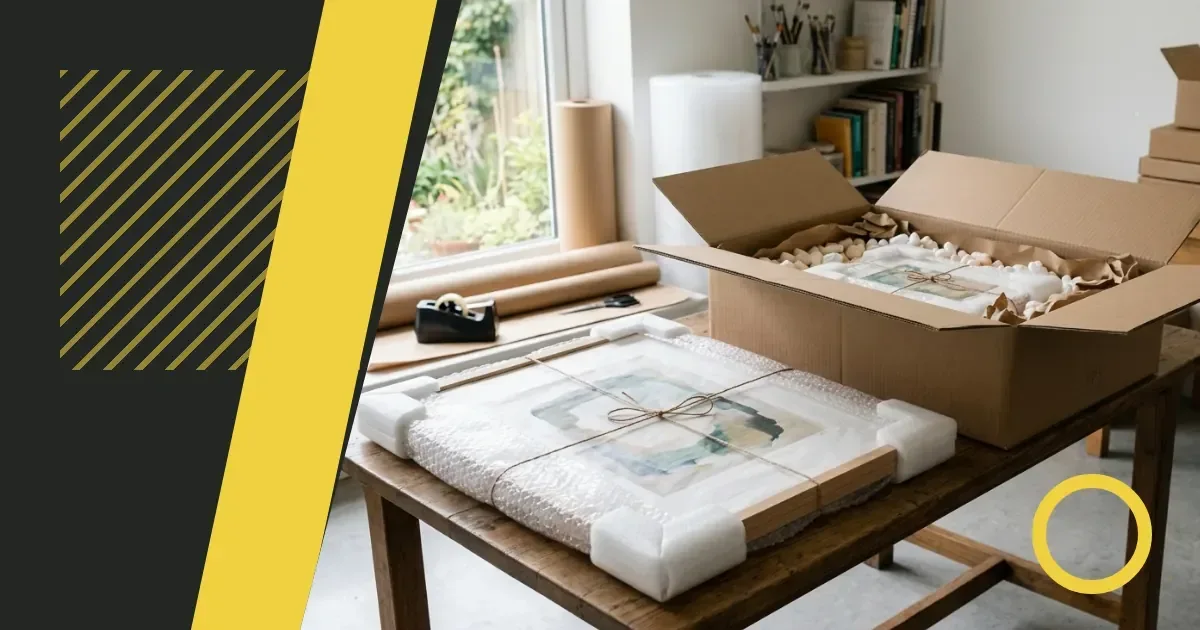
Wrap the painting in glassine or acid-free tissue first; this layer stops bubble wrap from leaving texture marks on paint that hasn't fully cured. Tape the tissue at the back of the stretcher bars, never on the painted surface. Then wrap bubble wrap around the whole piece with the bubbles facing outward, securing it with tape at the back.
Fit corner protectors on all four corners of the frame or stretcher. Cut a piece of cardboard slightly larger than the painting and tape it to the back as a rigid support. Slide the wrapped painting into a box with at least five centimetres of clearance on all sides, then fill the gaps with crumpled paper or foam inserts so the work cannot move when you shake the box.
Testing the package before you seal it
Lift the sealed box and tilt it in every direction. If you hear or feel the contents shifting, open it and add more cushioning. A properly packed painting sits motionless inside its box, held by materials that compress slightly under pressure but don't allow the work to slide or rotate.
Sending framed work without breaking the glass
Apply masking tape in an X shape across the glass on both sides of the frame. This holds the glass together if it cracks and stops shards from cutting into the artwork. Write "GLASS – HANDLE WITH CARE" on the outside of the box in large letters, and add a fragile sticker if the courier provides one.
Wrap the frame as you would a painting, but double the bubble wrap and ensure the corners have extra padding. Framed pieces are heavier, so choose a box with a weight rating that exceeds the total mass of the packed item. Reinforce the bottom seam of the box with extra tape, running it across the centre join and up both sides.
Packing prints and works on paper to prevent creasing
- Lay the print face down on a sheet of glassine or acid-free tissue and fold the edges over to cover it completely.
- Place the wrapped print between two pieces of rigid cardboard, each cut to the same size or slightly larger than the work.
- Tape the cardboard sandwich together around all four edges, making sure the tape does not touch the print.
- Slide the board into a stiffened envelope or a shallow box, then seal it and mark "DO NOT BEND" on both sides in bold letters.
For prints you're sending rolled, use a postal tube with a diameter wide enough that the print does not crease when it curves. Roll the print with the image facing outward, wrap it in acid-free tissue, then slide it into the tube and cap both ends. Mark the tube "ARTWORK – DO NOT CRUSH" along its length.
Protecting sculptures and three-dimensional work
Sculptures need internal support as well as external cushioning. Wrap delicate protruding parts individually in tissue, then bubble wrap, before wrapping the whole piece. If the sculpture has a base, pack it separately and include assembly instructions for the buyer.
Use a box large enough to leave space around the work on all sides. Fill the bottom with crumpled paper or foam, place the sculpture in the centre, then pack around it until the piece does not move. Heavy sculptures sit on a platform of doubled cardboard inside the box to spread their weight and stop them sinking through the base during handling.
Custom foam inserts for irregular shapes
When a sculpture has fragile parts that standard packing cannot protect, cut foam to fit around it. Trace the outline of the work on a sheet of dense foam, cut the shape slightly smaller so the foam grips without pressing hard, then slot the pieces together to cradle the sculpture inside the box. Test by closing the box and turning it upside down; the sculpture should stay in position.
Selecting a courier and service level that suits the value of the work
Compare tracked services from couriers who handle fragile items regularly. Standard postal services suit prints and small unframed works with a value below a certain threshold; anything more valuable or fragile travels better with a courier that offers proof of delivery and compensation if the package is lost or damaged.
Declare the full value of the artwork when you book the service. Undervaluing the shipment to save on fees means you receive less compensation if something goes wrong. Read the terms of the courier's insurance and decide whether to add extra cover for high-value pieces. Keep the tracking number and proof of postage until the buyer confirms the work has arrived safely.
| Shipping method | Suits | Tracking | Typical cover |
|---|---|---|---|
| Standard post | Prints, small unframed works | Basic | Limited statutory compensation |
| Tracked parcel | Canvas paintings, framed work under a moderate value | Full tracking, signature on delivery | Declared value up to a set limit |
| Specialist art courier | High-value or very fragile work | Real-time updates, named handler | Agreed value, additional insurance available |
Labelling the package so handlers know it's fragile
Write handling instructions in waterproof marker on at least two sides of the box. Use plain language: "FRAGILE – ARTWORK INSIDE", "THIS WAY UP" with an arrow, "DO NOT STACK". Avoid relying only on printed labels, which can peel off in transit. Include your return address and the buyer's delivery address inside the box as well as on the outside, in case the outer label is damaged.
Place a delivery note inside the package with the buyer's contact number, the title of the work and any special unpacking instructions. If the piece needs to acclimatise before unwrapping — for instance, if it has travelled in cold weather — write that clearly on the note.
Recording the condition before you send it
Photograph the artwork from several angles before you pack it, capturing any existing marks or imperfections. Photograph the packaging process too: the wrapped work, the inside of the box before you close it, and the sealed box with its labels. These images provide evidence of the condition the work left your studio in, which matters if the buyer reports damage or the courier investigates a claim.
Store the photographs with the rest of your records for that sale. Tracking your artwork sales includes keeping proof of how you shipped each piece, which courier you used and when the buyer confirmed delivery. If you insure your outgoing work, your insurer may ask for this documentation when you make a claim.
Agreeing shipping terms with the buyer before you pack
Clarify who pays for shipping, what level of service the buyer expects and whether they want insurance added. Some buyers prefer to arrange their own courier, particularly for large or valuable work; in that case, agree on a collection date and make sure the work is ready to go. If the buyer collects in person, prepare the piece for safe transport but let them decide whether to take it unwrapped or packed.
When you're shipping internationally, check customs requirements for the destination country. Declare the work accurately and include all necessary paperwork inside the package. Undervaluing artwork to reduce import duties is a customs offence and leaves you uninsured if the work is lost. Protecting your work means shipping it legally and transparently, even when that adds to the cost.
What to do if the work arrives damaged
Ask the buyer to photograph the damage before they unpack the work fully, and to keep all the packaging materials. Contact the courier immediately to report the damage and start a claim. Provide the photographs you took before shipping, the images of the packed box and the buyer's photographs of the damage. The courier will investigate and, if your claim succeeds, compensate you up to the declared value.
Decide whether you can repair the work, offer a partial refund or remake the piece. Some buyers accept a discount if the damage is minor and you offer to repair it at no charge. Others prefer a full refund and to return the work. Handle these conversations calmly and document everything in writing; your professional response to a problem protects your reputation as much as the quality of your packing does.
#Artwork sales #Artist records
Download PDF: Your artwork shipping checklist PDF, 29 KB
Further reading
Frequently asked questions
What materials do I need to ship a painting safely?
You need glassine or acid-free tissue, bubble wrap with the bubbles facing outward, corner protectors, a rigid cardboard backing board, a sturdy box with clearance on all sides, and packing material such as crumpled paper or foam to fill gaps and stop the painting moving.
How do I stop glass breaking when I send framed artwork?
Apply masking tape in an X shape across the glass on both sides of the frame to hold it together if it cracks. Use double bubble wrap, extra corner padding, a box rated for the weight, and mark the outside clearly with "GLASS – HANDLE WITH CARE".
Should I insure artwork when I ship it to a buyer?
Yes, particularly for high-value or fragile work. Declare the full value when you book the courier and add extra insurance if the standard cover is not enough. Keep proof of postage and the tracking number until the buyer confirms safe delivery.