What independent artists need: a practical starting checklist
 Save
Independent artists need more than talent and materials to build a sustainable practice. The gap between making work and making a living from it is practical: it comes down to systems, records and habits that most art education skips over. At Eclectic Art Studio, we focus on exactly those gaps — the unglamorous decisions that shape whether an artist's practice lasts. This article covers what to prepare, what to track and what to set up before the demands of the work outpace your ability to manage them.
The studio foundation: workspace and equipment
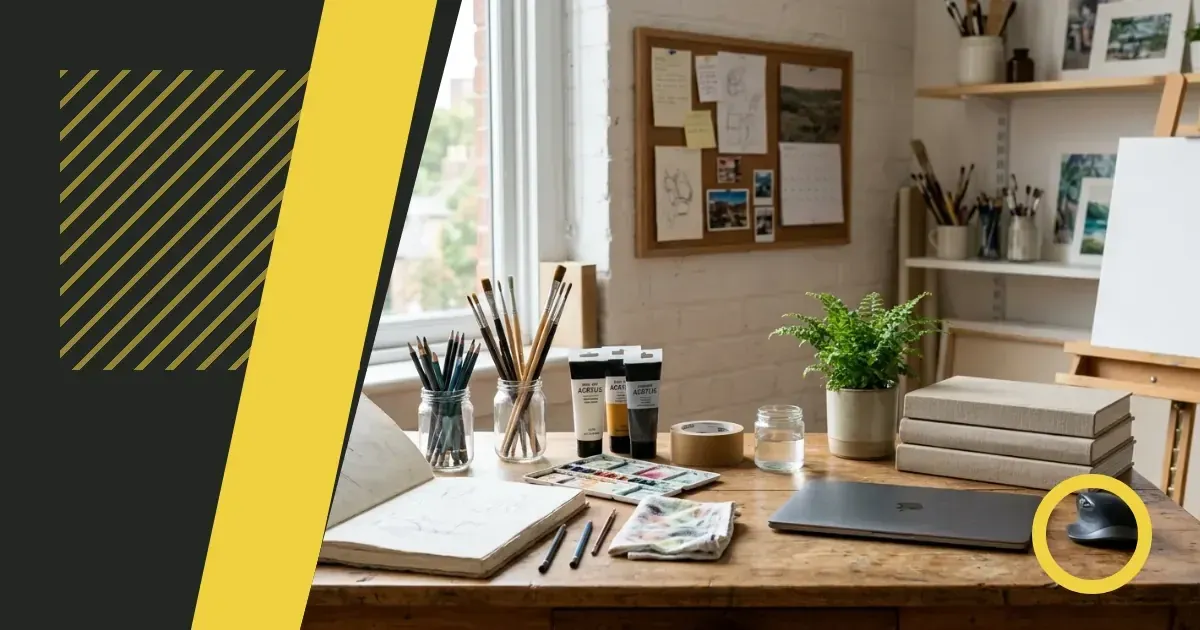
A dedicated space — even a corner of a room — changes how seriously you and others treat your work. Consistency of place builds consistency of habit. It does not need to be large or expensively fitted out.
What matters is that the space is set up for your medium without having to reconstruct it each session. That might mean a fixed easel, a shelf with materials in a known order, or simply a desk kept clear for drawing. The less friction between you and the work, the more likely you are to show up.
- Natural or adjustable artificial light suitable for colour-accurate work
- Storage that keeps materials accessible but protected
- A surface for wet or drying work separate from your main working area
- A phone or camera within reach for documenting work in progress
Building a portfolio that actually represents your work
Your art portfolio is the first thing most collaborators, buyers and venues ask for. It is not a complete archive — it is a curated selection that shows what you do at your best and where you are heading.
Photograph every finished piece in consistent, neutral light before it leaves your hands. A low-resolution image after the fact, if you can get one at all, serves no one. High-quality digital files give you the source material for prints, applications, social media and licences.
Aim for a portfolio that can be shown in two formats: a physical folder for in-person meetings and an online version linked from a simple website or a professional profile. The online version should load quickly and work on a phone screen.
Common mistakes in early record-keeping
Many artists start tracking sales and expenses only once the paperwork becomes painful. By then, receipts are missing, prices are forgotten and HMRC deadlines feel sudden. Starting records early costs little time and saves a great deal later.
The records an independent artist needs from the beginning fall into two categories: financial and creative. Both matter to your practice in different ways.
Financial records worth keeping from day one
Track every sale, every material purchase and every expense tied to your practice — studio rent, framing, postage, subscriptions. A simple spreadsheet works; the discipline matters more than the software. Tax planning becomes manageable when records are current rather than reconstructed.
Keep invoices and receipts, even small ones. Log the date, the amount and what it was for. When late payment arises, a clear invoice trail is the difference between a quick resolution and a protracted one.
Creative records and reference notes
A log of finished works — title, medium, dimensions, sale price or current location — serves you when applying for residencies, exhibitions or grants. Reference notes on materials you have tried, suppliers you trust and techniques that worked stop you repeating avoidable experiments. Keep them somewhere you will actually look.
Where to find your first audience
Before approaching galleries or fairs, most independent artists build an audience through smaller, lower-stakes venues: open studio events, local markets, online platforms and artist communities. Each one teaches you something about how your work lands with real people.
An artist community is not just encouragement — it is practical intelligence. Other artists know which fairs are worth the fee, which platforms take too large a cut and which calls for submissions are genuine. That knowledge is hard to find anywhere else and arrives faster through relationships than through research.
Art feedback from peers is most useful when it is specific and when you have asked a clear question. "What do you think?" rarely produces what you need. "Does this read as finished?" or "Which of these two titles is clearer?" does.
Artist statement and professional presentation
An artist statement is a short piece of writing that explains your work, your process and your influences to someone who has not met you. Galleries, residencies and grant applications almost always ask for one. Writing it before you need it — and updating it as your work changes — is far less stressful than writing it under deadline.
Our article on writing an artist statement that speaks for your work walks through the process in six practical steps, from identifying what your work is really about to refining the language until it sounds like you, not a press release.
Professional presentation also means having a short biography, a consistent name or studio name across platforms, and a clear way for people to contact you. These are not vanity details — they determine whether interest converts into a conversation.
Pricing, selling and protecting your work
Pricing is where most emerging artists undercharge, partly from uncertainty and partly from not wanting to seem presumptuous. Both are understandable, neither serves you. A considered pricing strategy — one that accounts for materials, time, overheads and market position — is a form of professional respect, to yourself and to buyers who understand value.
Our guide on how to price your artwork with confidence covers the six factors that matter most, including how to handle the awkwardness of charging what the work is worth.
Copyright in your work exists from the moment you create it in the UK — you do not need to register it. What you do need to understand is how it applies when you licence work, sell prints or share images online. Art licensing lets you retain ownership while allowing others to use the work under defined conditions. Know what rights you are granting before you agree to anything.
If you plan to sell prints, giclée printing is the archival standard for fine art reproductions. Our article on how to sell art prints covers the full process, from choosing a print partner to fulfilling orders and setting prices that reflect the quality of the output.
Steps to take when you are ready to start
The practical groundwork does not have to happen all at once. Working through it in a deliberate order stops the setup feeling overwhelming.
- Set up a dedicated workspace, however modest, and keep it consistent between sessions.
- Photograph every finished piece before it leaves your hands and store the files in one named folder.
- Open a simple spreadsheet for sales and expenses and log every transaction from today forward.
- Write a first draft of your artist statement, even if it is rough — something to revise is more useful than a blank page.
- Identify two or three artist communities or local open events where you can show work and meet peers.
Tools and formats compared
| Task | Low-cost option | Paid or dedicated option | What to consider |
|---|---|---|---|
| Portfolio hosting | Free website builder or social profile | Dedicated artist website platform | Ownership of your domain and data matters long-term |
| Financial records | Spreadsheet (manual) | Accounting software | A spreadsheet works fine until invoicing volume grows |
| Image storage | Cloud folder (free tier) | Paid cloud storage or external drive | Redundancy matters — keep files in two places |
| Artist statement | Word processor draft | Feedback from a peer or mentor | The quality of the revision matters more than the tool |
Creative habits that sustain independent practice
The practical systems above exist to protect the creative work, not replace it. Artists who build sustainable practices tend to guard their making time — they treat it as a fixed commitment rather than something fitted around everything else.
Creative block is real, but it is rarely about inspiration. More often it is about pressure, isolation or unclear next steps. Having a list of small, low-stakes tasks for difficult days — sketching, tidying the studio, reviewing reference notes — keeps momentum without forcing finished work.
Setting creative boundaries matters too: knowing when to accept commissions, when to decline, and how to communicate both without damaging a relationship. That clarity comes from knowing your own priorities, and it is worth thinking through before the first request arrives.
#Art portfolio #Artist statement #Studio practice
Download PDF: Independent artist starter checklist PDF, 28 KB
Frequently asked questions
What does an independent artist actually need to start selling their work?
The basics are a consistent body of work with good photographs, a way for buyers to contact you, and a clear price for each piece. Before your first sale, it also helps to have a simple system for recording transactions and issuing invoices, so the paperwork does not catch up with you later.
How do independent artists find communities or networks early in their career?
Open studio events, local art markets and online forums run by artists are the most accessible starting points. Artist communities are worth seeking out not just for encouragement but for practical intelligence about which opportunities are worth pursuing and which are not.
What records should an independent artist keep from the very beginning?
Keep a log of every sale, including the buyer's name, the price and the date. Track all expenses tied to your practice — materials, framing, postage, subscriptions. A separate creative log of finished works, their dimensions and their current location is useful for applications and exhibitions.