Understanding and choosing chinoiserie chests of drawers
 Save
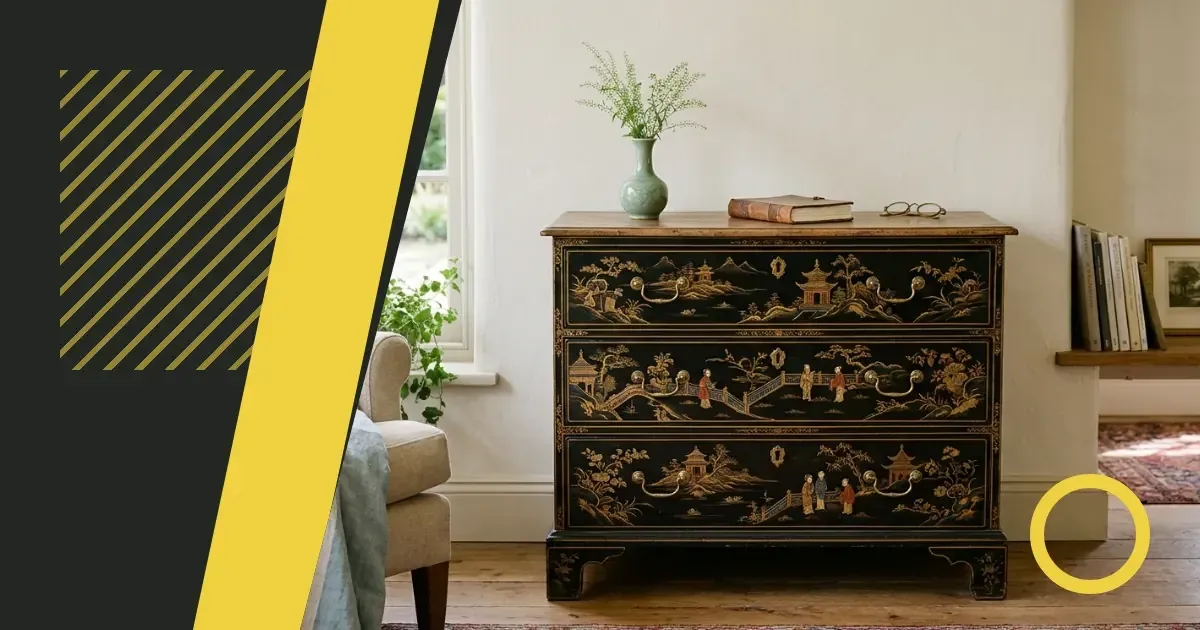
A chinoiserie chest of drawers blends European furniture forms with hand-painted decoration inspired by Chinese art, creating pieces that work as both storage and statement. This guide from Eclectic Art Studio walks you through recognising genuine examples, understanding what you're looking at, and deciding whether one belongs in your work or living space.
Recognising chinoiserie decoration
Chinoiserie emerged when European craftspeople interpreted East Asian motifs without direct knowledge of the originals. Look for stylised landscapes with pagodas, willow trees and distant mountains, often rendered in black lacquer on a coloured ground or painted directly onto wood. Figures wear flowing robes and appear in garden scenes or crossing arched bridges. Birds, particularly long-tailed species, and flowering branches feature heavily.
The decoration differs from authentic Chinese work in its approach to perspective and proportion. European painters often exaggerated scale, mixed motifs from different traditions, and added fanciful details. This imaginative quality is part of chinoiserie's character rather than a flaw. A piece showing confident brushwork and a cohesive palette—reds, golds, blacks and greens on cream, dark blue or vermilion grounds—suggests skilled execution regardless of historical accuracy.
Checking construction and age
Turn your attention to how the chest is built once you've assessed the surface. Drawers in older pieces slide on wooden runners and show wear where they've been opened thousands of times. Dovetail joints—the interlocking fingers at drawer corners—were hand-cut until the mid-nineteenth century and show slight irregularities. Machine-cut dovetails, perfectly uniform, indicate later manufacture or reproduction.
The back and underside reveal construction methods. Eighteenth-century examples often have unfinished interiors with saw marks and irregular planing. Later pieces may use plywood or particle board in hidden areas. Original brass handles develop a soft patina and may show replacement screws where fittings were updated over time. Mismatched hardware isn't necessarily negative—it can confirm a piece has been used and maintained across generations.
Placing one in your space
A chinoiserie chest brings pattern and colour to rooms that might otherwise feel sparse. In a bedroom it serves as a focal point opposite the bed or along a side wall, holding linens and clothing while offering a surface for lamps or collected objects. Hallways and landings suit narrower examples, where the decoration can be appreciated without crowding the sight line.
Pairing chinoiserie with contemporary furniture often works better than surrounding it with other ornate pieces. A plain linen sofa, simple rugs and uncluttered walls let the chest's decoration stand out. If you prefer a layered look, limit additional pattern to one or two textiles and keep other furniture lines clean. The chest itself provides sufficient visual interest.
Caring for painted and lacquered surfaces
Dust regularly with a soft cloth, working gently over painted areas where the surface may be fragile. Avoid furniture polish containing silicone or harsh solvents, which can dull original finishes or lift paint. A barely damp cloth followed immediately by a dry one removes marks without saturating the wood.
Keep the chest away from radiators and direct sunlight, both of which cause wood to shrink and paint to crack. Maintain consistent humidity if possible—sharp changes make joints loosen and veneers lift. Small losses to decoration are part of a piece's history; attempting amateur repairs often causes more damage than leaving them alone. Consult a conservator for anything beyond light cleaning.
Deciding between antique and reproduction
Genuine period examples carry higher prices and require careful handling, but offer historical depth and often superior craftsmanship. Reproductions provide the aesthetic at lower cost and may better suit active households where the risk of damage matters. Neither choice is inherently better—your priorities around budget, authenticity and practicality decide which serves you.
When considering an antique, ask about provenance and request a condition report if buying remotely. Check drawer function, structural stability and the extent of restoration. Well-executed reproductions can be beautiful objects in their own right; look for solid construction, hand-painted decoration where possible, and finishes that develop character rather than imitating artificial ageing.
| Feature | Antique indicator | Reproduction sign |
|---|---|---|
| Dovetails | Hand-cut, slight variation | Uniform machine joints |
| Paint surface | Crackling, wear in logical places | Even finish, artificial distressing |
| Hardware | Soft patina, possible replacements | Bright or artificially aged brass |
| Interior | Hand-planed, unfinished wood | Smooth machine finish, modern materials |
Sourcing and where to look
Antique dealers, auction houses and specialist furniture fairs offer the widest range of period pieces with varying levels of condition and price. Viewing in person lets you assess construction and decoration quality firsthand. Online marketplaces expand your reach but require careful questioning about condition, dimensions and return policies.
For reproductions, furniture makers working in traditional methods produce higher-quality results than mass-market imports. Ask about the decoration process—hand-painted designs command higher prices but show individuality that printed or transfer decoration lacks. Commissioning a piece allows you to specify dimensions, colour palette and motif selection to suit your space exactly.
What the decoration tells you
Motifs can help date a piece and identify its origin. Early eighteenth-century English examples often show figures in gardens with elaborate architecture, while later pieces simplified scenes into repeating border patterns. French chinoiserie favoured lighter grounds and more delicate brushwork. Pieces made outside Europe during the colonial period sometimes blend local decorative traditions with chinoiserie conventions, creating hybrid styles.
The quality of painting varies enormously. Furniture intended for grand houses received meticulous decoration by skilled artists, with fine detail and balanced compositions. Simpler examples for broader markets used stencilled outlines filled with hasty brushwork. Neither approach makes a piece unworthy—assess whether the decoration suits your taste and whether the overall effect holds together when you step back.
Frequently asked questions
How can you tell if chinoiserie decoration is original to the piece?
Original decoration shows wear consistent with the furniture's age—paint loss at edges and high points where hands touch, crackling that follows wood grain, and a patina developed over time. Modern additions often look too fresh, sit on top of existing finishes rather than integrated with them, or show artificial distressing applied uniformly.
What should you look for when examining drawer construction?
Check that drawers slide smoothly, dovetail joints fit tightly without gaps, and the drawer base sits securely in its grooves. Hand-cut dovetails show slight irregularities; machine-cut joints appear perfectly uniform. Wear on the bottom edges of drawer sides and on the runners inside the case confirms genuine use.
How do you clean a painted chest without damaging the surface?
Dust regularly with a soft, dry cloth, using gentle pressure over painted areas. For marks, use a barely damp cloth followed immediately by a dry one, avoiding any scrubbing motion. Never use furniture polish with solvents, silicone or wax on painted or lacquered surfaces, as these can dull finishes or lift fragile paint layers.